

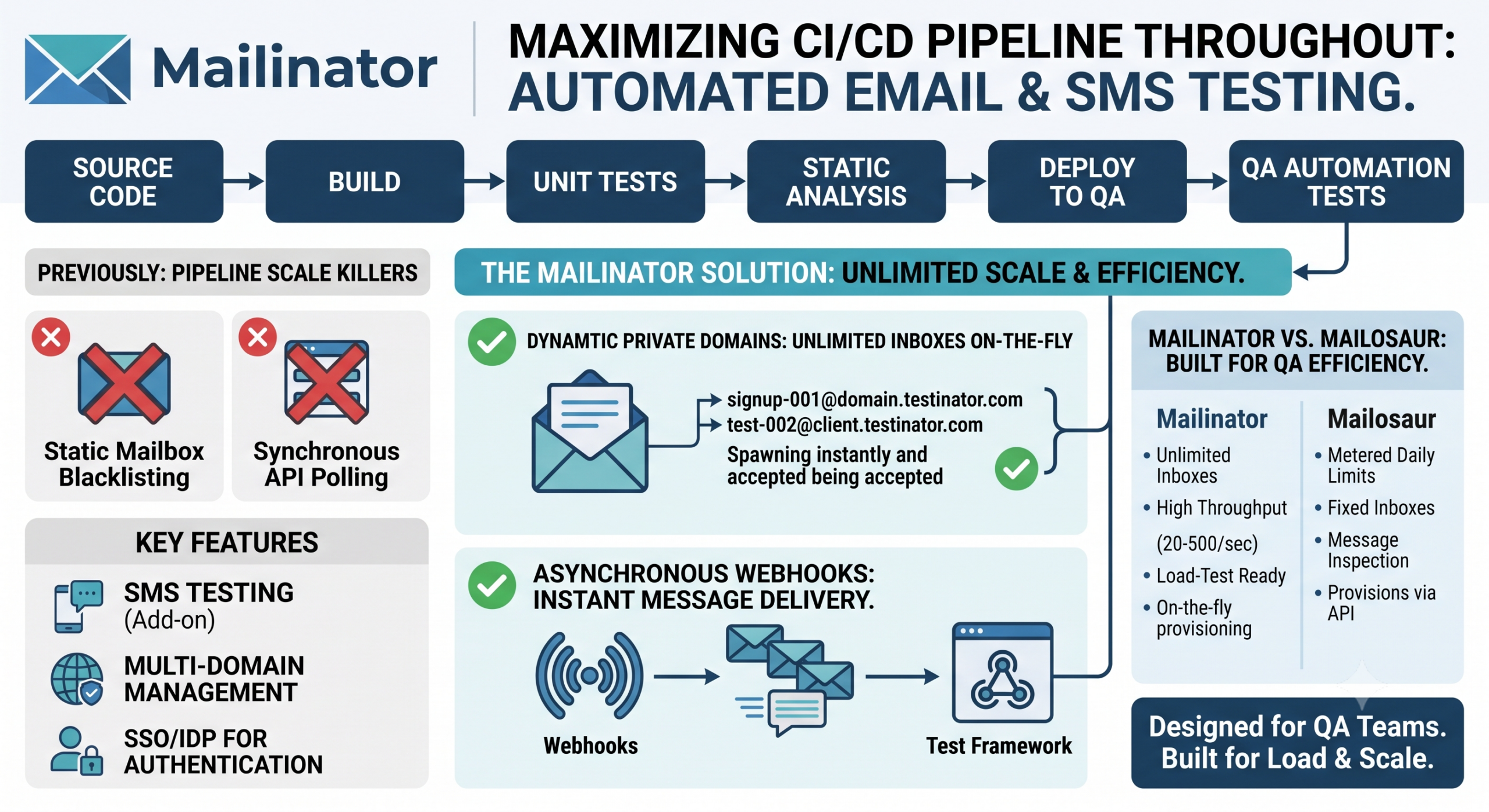
A practical comparison for QA engineers and automation testers — and why Mailinator is the better long-term choice.
Does your application send email or SMS? Then your test suite has to be able to read those messages back. Registration confirmations, one-time passwords, password resets, and magic links all live or die on a message arriving correctly. So both Mailinator and Mailosaur exist to help QA teams automate exactly that. However, they solve that problem in different ways. This guide breaks down where each fits. It also makes the case for why most QA teams get more value from Mailinator.
What’s the difference between Mailinator and Mailosaur?
Mailinator is a private message-routing system built for automation and scale. First, you point a private domain at Mailinator. Then every address on that domain becomes a testable inbox instantly, with no provisioning. Your tests reach it through the API, webhooks, and routing rules. As a result, it fits teams running email and SMS workflow tests. It plugs into frameworks like Selenium, Cypress, Playwright, and Puppeteer. It also handles high-volume and load-testing scenarios.
Mailosaur, meanwhile, leans toward message inspection and rendering. For example, it offers inbox-based testing, virtual SMTP servers, and email previews. Those previews cover clients like Gmail and Outlook. It adds accessibility and content analysis too. So it’s a capable product, particularly for visual email QA. However, its plans meter usage around smaller daily volumes and per-inbox limits.
The short version: Mailinator is built to scale with your automation; Mailosaur is built to inspect individual messages.
How do Mailinator and Mailosaur compare on pricing?
Mailinator’s paid plans start at $79/month (Business, billed yearly). That tier includes five team seats, 100,000 emails per month, and a private testing domain. Mailosaur’s cheapest paid plan, Personal, starts at $20/month billed annually. However, it covers only a single user, one inbox, and 15,000 inbound emails per month, with a 500-email daily cap. Meanwhile, its team-oriented Core plan runs $50/month for five seats and 75,000 emails per month.
On a straight per-seat basis, Mailosaur can look cheaper. But the moment you compare headroom, Mailinator pulls ahead. For instance, Business gives you more monthly volume than Mailosaur’s top standard plan. And Mailinator keeps climbing. Business Plus ($159/mo) delivers 300,000 emails per month across three domains. Enterprise then scales to 3 million-plus emails per month. With Mailosaur, moreover, SMS and email previews cost extra as separate add-ons.
Can you actually start testing for free?
With Mailinator, yes — genuinely free, not a countdown trial. For a start, anyone can use the free public inboxes at mailinator.com, with no signup at all. And for automation, the Verified Pro plan stays free. It includes a private domain, unlimited private inboxes, and API access. So you can wire up a real automated test against your own domain without paying anything.
Mailosaur, by contrast, has no free tier. Instead, you get a 14-day trial. After that, testing requires a paid subscription. So for a QA engineer who wants to prove out an approach before asking for budget, that’s a real difference.
Mailinator lets you validate your automation approach for free first, then upgrade for volume — instead of committing to a subscription to run your first test.
Which platform is better for automation and high-volume testing?
This is where the gap is widest. Mailinator supports 20 to 500 emails per second, depending on plan. It also explicitly targets load testing. That is, it checks that your delivery systems hold up when you fire ten, ten thousand, or ten million messages at them. Mailosaur, however, meters usage in daily limits (500/day on Personal, 2,500/day on Core). That works fine for functional test suites. But it won’t cover load or bulk-receipt testing.
So imagine your email volume grows with your user base. Or picture a notification pipeline you need to stress-test before a launch. In both cases, Mailinator’s throughput and monthly ceilings remove a constraint you would otherwise hit.
How do the two handle inboxes and private domains?
Mailinator gives you unlimited private inboxes on your own domain. Any address goes live the instant you use it, with no need to pre-create mailboxes. As a result, it maps cleanly to automation. Each test run often spins up a fresh, unique address, like signup-<timestamp>@yourdomain.testinator.com. Mailosaur’s Personal plan, by contrast, includes a single inbox. So multiple inboxes require the Core plan.
Therefore, CI pipelines often generate throwaway addresses per test, per branch, or per worker. Mailinator’s on-the-fly model then means less setup and no inbox bookkeeping.
What about SMS and workflow testing?
Both platforms support SMS testing. In both cases, you request phone numbers on demand as an add-on. However, Mailinator treats email and SMS as parts of the same workflow — 2FA, OTP, password reset, and onboarding flows. For example, it adds webhooks, routing rules, and an SSO-capable Universal IDP for single sign-on. It also ships up-to-date Ruby and JavaScript SDKs. So you can drive it all from your test code.
Where is your test data stored?
Mailinator, meanwhile, is wholly owned and operated in the United States. It keeps its servers and employees in the U.S. Mailosaur, by contrast, is a UK-based company headquartered in Basingstoke. So that distinction can prove decisive for teams with U.S. data-residency rules. Still, it’s worth confirming against your own compliance needs.
When would Mailosaur be the better fit?
To be fair, Mailosaur can be the better pick in some cases. For example, picture a team focused on visual email QA. They want to preview exactly how a message renders in Gmail, Outlook, and on mobile. They also want accessibility checks and content analysis. For that work, Mailosaur’s previews and message-analysis tooling shine. So teams that care most about how an email looks may prefer it. It’s a good product; it simply optimizes for a different center of gravity.
The verdict: why QA teams choose Mailinator
Most QA teams hire an email-testing tool for one core job. They want to reliably automate email and SMS workflow tests and scale them without hitting a wall. For that job, Mailinator is the stronger choice. First, you can start for free and prove the approach. Then private domains and unlimited on-the-fly inboxes fit naturally into automation. Meanwhile, throughput and monthly volume scale from a hundred thousand messages to millions. Mailosaur, of course, is capable and especially good at visual inspection. However, its daily limits, per-inbox model, add-on pricing, and lack of a free tier make it a tighter fit as you grow.
Choose Mailinator when email testing is part of your automation strategy — not just an occasional visual check.
How to get started with Mailinator
- First, start free with Verified Pro. Get a private domain, unlimited private inboxes, and API access at no cost. That’s enough to build and run a real automated email test.
- Then wire it into your framework. Use the API and SDKs with Selenium, Cypress, Playwright, or Puppeteer to fetch OTPs, confirm links, and assert on content.
- Next, move to a private testing domain early. Route tests through your own domain rather than the public inbox. Your test data then stays isolated and predictable.
- Finally, scale up when you need to. Upgrade to Business or Business Plus for more seats, volume, and domains. Or choose Enterprise for load testing at millions of messages per month.
At a glance: Mailinator vs. Mailosaur
| Mailinator | Mailosaur | |
|---|---|---|
| Free tier | Yes — free public inboxes (no signup) + free Verified Pro plan with a private domain and API access | No free tier — 14-day trial only |
| Entry paid price | $79/mo (Business, billed yearly) — 5 seats | $20/mo (Personal, billed annually) — 1 user |
| Monthly email volume | 100K (Business) → 300K (Business Plus) → 3M+ (Enterprise) | 15K (Personal) → 75K (Core) |
| Throughput / load testing | Up to 20–500 emails/sec; purpose-built for load testing | Daily caps (500–2,500/day); not positioned for load testing |
| Inboxes | Unlimited private inboxes; any address on your domain, created on the fly | 1 inbox (Personal) / multiple (Core), each with unlimited addresses |
| Private domains | 1 (Business) → 3 (Business Plus) → 5+ (Enterprise) | Unique domain per inbox |
| SMS testing | Yes (numbers by request, add-on) | Yes (add-on from $37.50/mo) |
| Data residency | 100% U.S. owned and operated | UK-based (Basingstoke, UK) |
| Best fit | Automation, high-volume and load testing, teams that scale | Visual email QA, previews across clients, accessibility checks |