

Not every Mailinator SDK release arrives with a marquee feature. Sometimes, however, the important work is keeping the client your application depends on secure, testable, and aligned with the API it represents.
Recently, we published updates to four official Mailinator SDKs. Each release has a different scope. Still, they all share one goal: a healthier baseline for developers who use Mailinator from their preferred language.
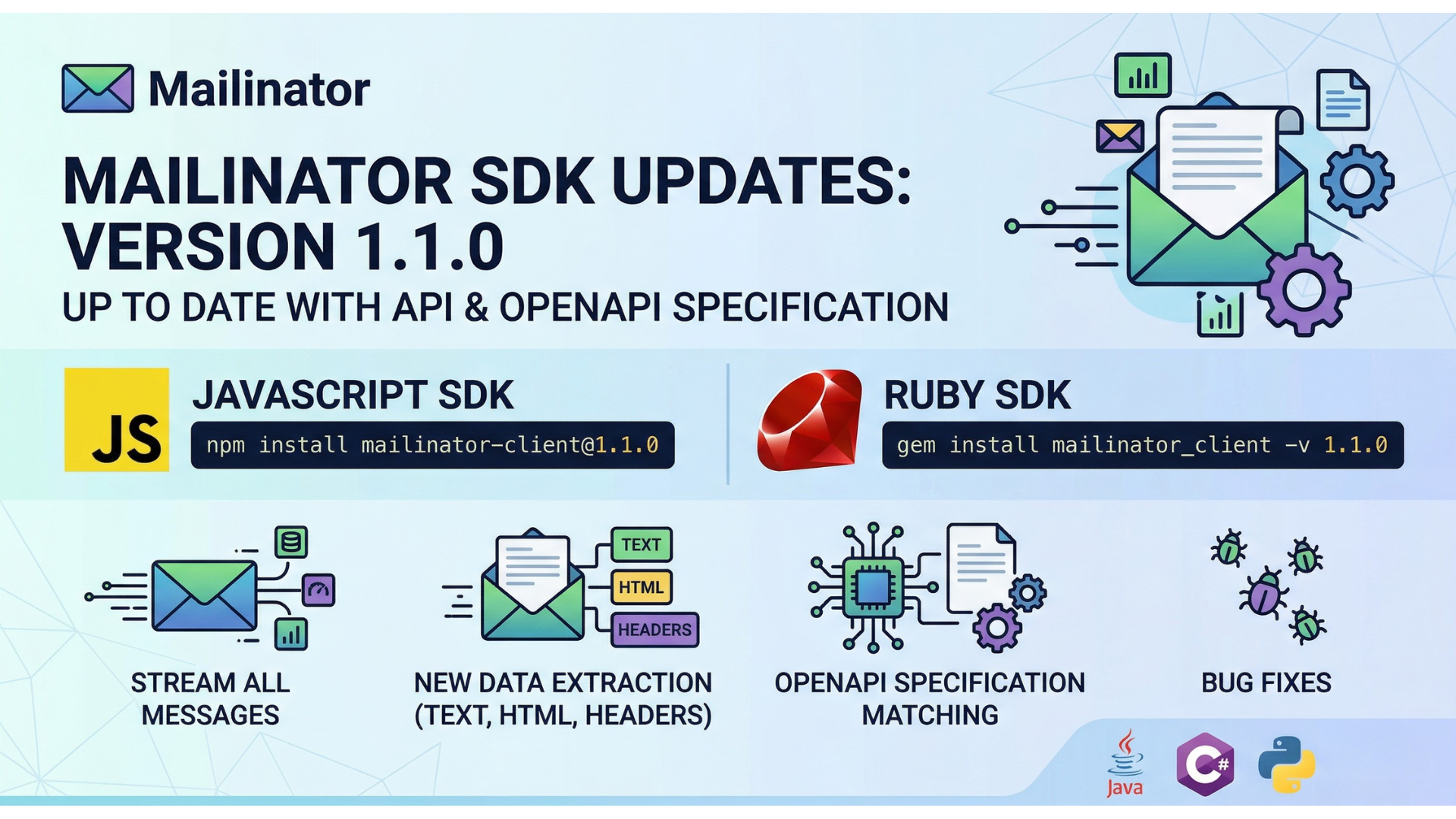
What changed in the latest Mailinator SDK releases?
In short, four clients got new versions. Here is the quick summary before we dig into each one:
- C# 2.0.0: a major update from 1.0.6 with new endpoints, rewritten docs, offline tests, and a RestSharp 114 upgrade.
- Python 1.0.9: mocked endpoint tests, new message endpoints, and a new minimum of Python 3.10.
- JavaScript 1.1.2: dependency security fixes and more reliable testing.
- Ruby 1.1.1: security fixes in httparty, so the client now needs Ruby 2.7 or newer.
This round also builds on our earlier Ruby and JavaScript SDK v1.1.0 release, which brought both clients up to date with the API.
Mailinator SDK for C#: version 2.0.0
Mailinator C# SDK 2.0.0 is a major update from 1.0.6. Above all, it makes the SDK more complete, easier to understand, and easier to maintain.
First, the release adds new API coverage:
- Domain-wide message listing
- Message summaries, headers, and text content
- Webhook injection for both domains and inboxes
In addition, the documentation got a full refresh. It now includes a rewritten README, examples, a roadmap, a changelog, an API reference, migration guidance, and a testing guide. The SDK also marks deprecated operations explicitly, so you know what to move away from.
Behind the scenes, 2.0.0 adds offline request and serialization tests plus OpenAPI coverage checks. It also adds CI and release workflows, dependency updates, and reproducible package locks.
Finally, the release upgrades RestSharp from 112 to 114. It also fixes message sort serialization and forwards the optional message-deletion parameter. However, RestSharp types are part of the SDK’s public API. As a result, this upgrade includes some consumer-facing migration work, so read the migration guidance before you bump the version.
Mailinator SDK for Python: version 1.0.9
Python 1.0.9 combines maintenance work with real gains in API and test coverage.
For example, it adds mocked endpoint tests. These tests exercise request dispatch, response handling, model deserialization, warnings, and required-parameter validation. Best of all, they run without Mailinator credentials.
The release also adds support for domain message listing. In addition, you can now retrieve message summaries, text, and headers.
Meanwhile, duplicate singular authenticator requests now route through the canonical /authenticators/ endpoints. We also refreshed the dependency pins. Finally, the minimum supported Python version rises to 3.10, so check your runtime before you upgrade.
JavaScript 1.1.2: dependency health and reliable tests
The JavaScript update is mostly maintenance. Specifically, it targets dependency health and reliable testing.
First, it updates and pins dependencies to address known security vulnerabilities. Next, it swaps a test-only UUID dependency for Node’s built-in crypto.randomUUID(). It also refreshes TypeScript and test tooling. In addition, a test-specific TypeScript configuration now keeps Jest and ts-jest compiling consistently.
On top of that, contributors get clearer guidance on keeping the SDK aligned with the Mailinator OpenAPI specification.
Ruby 1.1.1: a security-focused release
Ruby 1.1.1 exists mainly to close security gaps.
First, it updates httparty to address an SSRF and API-key leakage vulnerability. It also adds an updated development dependency on addressable to fix a URI-template ReDoS vulnerability.
However, the fixed httparty line needs Ruby 2.7. As a result, the SDK now supports Ruby 2.7 and newer. So if you use the Ruby client, your Ruby version is the key thing to check before you upgrade.
How do I upgrade each Mailinator SDK?
Each client ships through its usual package manager. Before you upgrade, though, check the note for your language:
| Language | Install command | Check before upgrading |
|---|---|---|
| C# 2.0.0 | dotnet add package MailinatorApiClient --version 2.0.0 | RestSharp 114 migration work |
| Python 1.0.9 | pip install mailinator-python-client-2==1.0.9 | Python 3.10 or newer |
| JavaScript 1.1.2 | npm install mailinator-client@1.1.2 | Mostly a drop-in update |
| Ruby 1.1.1 | gem install mailinator_client -v 1.1.1 | Ruby 2.7 or newer |
Continuing the OpenAPI alignment work
We’re continuing to bring the C# and Python SDKs in line with Mailinator’s OpenAPI specification. That work isn’t finished yet. Still, both clients are now much closer to full alignment.
Each update gives the client a better starting point. In other words, you get clearer supported operations, more useful tests, healthier dependencies, and better signals about deprecated APIs.
If you use one of these SDKs, we’d love to hear how the upgrade goes. Also, tell us what would make the client more useful for your work. And if you’re still choosing a stack, our guide to the best email testing tools for QA teams shows where Mailinator fits.
Mailinator SDK FAQ
Which release has breaking changes?
C# 2.0.0 is the major release. Because RestSharp types are part of its public API, the move to RestSharp 114 means some migration work. In addition, Python 1.0.9 and Ruby 1.1.1 raise their minimum runtime versions to 3.10 and 2.7.
Do the new Python tests need Mailinator credentials?
No. The mocked endpoint tests run offline, so you can validate request and response handling without an API key.
Are the SDKs fully aligned with the OpenAPI specification?
Not yet. The C# and Python clients are closer than before, and that alignment work continues in upcoming releases.
Release links
- JavaScript 1.1.2: changelog · npm package
- Ruby 1.1.1: changelog · RubyGems package
- C# 2.0.0: changelog · NuGet package
- Python 1.0.9: changelog · PyPI package